Showing posts with label Nagasaki. Show all posts

Tuesday, December 15, 2009

2: July 21,1917 Nagasaki: Somewhere in Japan

After a fine trip across, the pilgrim duly arrived at the port of Nagasaki, where several formalities had to be observed previous to disembarking. Immediately after dinner on board the previous evening, each passenger was presented with a form, containing many queries, designed to elicit much intimate and interesting information with respect to his, or her, past, the present and their intentions in the future.

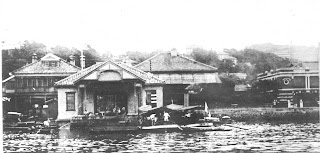
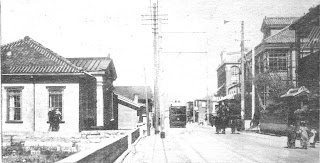
Nagasaki Customs and Oura-machi


Customs Hatoba, Nagasaki

The poor, over-worked Recording Angel, presumably, spent a busy couple of hours with his celestio-stylo pen, as filling up the line prefixed with the word "age" would materially increase his labours, judging from the number of ladies present.
There was also a less pleasant formality to be complied with, in accordance with the Sanitary Regulations of the port, of which, suffice it to be said earlier intimation might have been conveyed to the passengers.
The Doctor announced that all passengers were expected to muster in the Dining Saloon, at the unholy hour of 5 a.m., the steamer being expected to arrive at the Quarantine Station and anchored by daylight.

So, at five in the morning, behold a most variegated assemblage in the saloon. Kimonos, dressing gowns and negligees of striking hues and startling patterns; one particular garment of green, yellow and blue, with a chaste design of lobsters, crabs and other crustaceans in their natural (unboiled) colours, being particularly conspicuous. It was further noted that, in many instances, lovely woman differs considerably in figure, charms and in the abundance of what the "Koko" people term "her crowning glory," in the extremes of p.m. and a.m. Another instance of the eternal conflict between Art and Nature presumably.

After the Doctor's inspection was concluded, the Police held their little seance. In single file, the passengers advanced to a table whereat were seated two polite Japanese officials. Suavely polite, m'yes, but extremely business-like and their enquiries were conducted with a celerity and efficiency which was remarkable. One of these gentlemen was in mufti while the other, a monolinguist, was in full uniform, wore a sword and from the careful manner in which he handled same at frequent intervals, it was presumed that it was loaded and that its wearer had some doubt as to its going off unexpectedly.

Passports were demanded, inspected and the bearer's rank, social status, intentions, birthmarks and idiosyncrasies elicited; all very politely, but with a gentle insistence which led one to conclude that it is easier for a Campbell to crawl through the eye of a gramophone needle than for the undesirable to enter Japan.

Noting what was in store when his turn arrived, the pilgrim borne down by thoughts of his lurid past, began to quake. The pilgrimage seemed doomed at its very outset as, apparently, permission to enter Japan was granted solely to the creme de la creme and while worrying over the possibilities in store for him as one of the rejected, his passport was gently taken from his hand and ere he actually realised it, he was on the 'grille' and had received permission to range himself among the sheep.

Hitherto no 'goats' had been discovered but at this juncture, one was led in, doing his best to look sheepish, his conductor having caught him flagrante delicto, photographing the harbour from the saloon deck!
This ardent devotee of the sunny Art, will it be believed? was none other than a Vice-Consul (another instance of the vagaries of the Official Mind). Despite the numerous notices prominently displayed about the steamer, not to mention the many cases which he must have read of in the newspapers, Mr. Vice-Consul had been amusing himself by seriously fracturing the War Department Regulations while the inquisition was in session in the saloon.

Possibly, it was a fortunate thing for him that he occupied an official position, otherwise it might have gone hard with him. As it was, beyond the confiscation of the reel of film and some admonitory advice, he got off scot-free.

A little later on in the day, the pilgrim found himself within an ace of fracturing the local Police Regulations. Happening to require some article packed in his dressing case, a thorough search (fortunately) was necessary to discover same. The search, however, brought to light his automatic, very necessary elsewhere but of little use in Japan, which had somehow got packed up with the rest of his gear.

On landing at the Customs hatoba the pistol was promptly declared and a merry little scene ensued, the finale being the conveyance of the artillery to the customs bonded store, there to rest, well vaselined, until regained by its owner on his departure from Japan.

In due time the pilgrim found himself installed as a 'supernumerary' at the home of Mama-in-law, situated in the Hunki-dori-machi.
Hunkidori, it may be observed, is merely a figure of speech as, for obvious reasons, no precise intimation of the locality will be given, beyond the statement that this funny little house, with its garden and its smiling and willing service; perched on the side of a hill, is about the coolest spot in Nagasaki.


Higashi Yamate

The interior appears to consist, in the main, of primrose-coloured , paper screens and polished woodwork and the convenient electric light somehow, seems to be an anachronism.

From the verandah, a splendid view is obtained of the Harbour and that part of the town lying on the slopes below. The scenery seems to vary with time and season and during the evening, no student in the life class need go short of a model, either for the head or "the altogether," as 6 p.m. and bath-time synchronise hereabouts.

This results in many replicas of Messrs. Pears' advertising poster: "The Happy little Jappy in her tub." Yes; there is a Lady Godivaness about the p.m. scenery that is charming.


Tatami room

Saturday, December 12, 2009

Foreword: Leaves from the Diary of a Pilgrim 1917

Leaving Shanghai on the Korea Maru, bound for Nagasaki

Written by Sydney S. Kemp, Reporter for the Shanghai Times, c. 1917

Picture of Shanghai 1917

Foreword

In compliance with the Editorial request, for a sketchy description of the happenings and vicissitudes, incident to the writer's revisiting divers and sundry scenes in Japan; localities in many instances far of the beaten track of the Globe-trotter, these 'leaves' are the result.

No literary merit is claimed for these leaves, nor need any new or valuable information, starling discoveries, or erudite description of things Japanese, be sought for in this erratic itinerary, in which past, present and future tenses will be found laying cheek-by-jowl. The moods, also, are many in this sketchy record of the writer's impressions, jotted down as they were in his note-book while freshly imprinted upon his mind or memory.

Be it understood, furthermore, that naught herein has been set down in malice. It is now many years since the writer made the discovery which comes to all, sooner or later - that most objectionable things, or persons, are not worth the waste of tissue that a healthy, active hate and the desire to strafe involves.

The first axion in the writer's private lexicon of Philosophy, incorporated herein without extra charge runneth thusly: "Life is a huge leg, come, let us pull it." Hence, will the daimyo of Naniwa-machi and other captious critics please note, and not 'bazz' too many "windows."

It has been intimated that "the windows of these 'leaves' are many - and the errors thus rendered visible are conducive to unholy merriment among the illuminated. This is, indeed, good hearing. In these depressing and anxious times a good, hearty laugh is a valuable asset and the peripatetic pilgrim will be delighted to join in the merry "Ha-ha!" even though it be at his own expense.

At the outset, it was anticipated by the writer that the passage of over a score of years would bring about many and varied changes, Japan having adopted the policy of "push and go" and duly acquired the mania for improvements. These, while doubtless adding considerably to the amenities of existence, are apt to prove depressing amid once familiar scenes where one searches in vain for vanished landmarks.

Such a pull on his heart-strings, the writer anticipates on the occasion of revisiting Hankow, to discover the sylvan scene, once known as "Jardine's Timber Yard," improved' beyond recognition into shops and residential flats, as prophesied in the issue of the "Central-China Post" which arrived to hand this morning.

At first, it was intended to record the incidents of this pilgrimage to old shrines and dimly-remembered altars under such captions as "Through Fairy Land by Bike and Side-car," but as no member of the outfit knew anything concerning motoring, beyond laying back and giving orders as to speed or direction, the idea of motor-bike and side-car was reluctantly abandoned. The scheme of revisiting scenes first seen over a score of years past and recording a comparison between one's maturer impressions, with those formed during the earlier years of indiscretion, was no sudden impulse.

This intention had been steadily crystalling for several years and a fortuitous conjunction of incidents rendered the fulfillment of the desire possible. Once decided upon, if it were to be done it were well done quickly. Clothes were packed and the numerous incidentalae attendant upon these occasions duly attended to.

Followed the tour of the various steamer offices when "Booking a passage" was discovered not to be the simple thing it first appeared, Consular formalities having to be complied with also not tending to simplify matters. The applicant for a passage, everwhere was received with many regrets; so many, indeed, that an apt. latter-day rendition of the tag: - "There is sorrow on the sea" might appropriately read: There is much sorrow in the Passenger Department at the steamer offices, albeit unholy exuberant joy in the freight ditto, in consequence of the soaring rates.

Logo of the Japanese steamship company


In the offices of the Japanese companies, the regret was accompanied with much audible indrawing of breath on the part of the polite passenger clerks who were, at least they said so, "booked up solid for weeks ahead."


Ticket receipt


The applicant for a passage tried diplomacy. Duplicating the deep breathing exercises, he enquired in his best, No. 4 chop, Japanese, if there was not some vacant nook or corner on board where he could stow himself away, yea, even the dog-kennel? But Alas! All to no purpose, seemingly, even the dog-kennels had been pre-empted.

But it came to pass, one day the Pilgrim had converse with a certain wise man and, while paying for the refreshments, the oracle spake unto him, saying: "You try the Toyo, I hear that there are one or two vacant berths."

Verily, verily, out of bars, refreshment rooms and places where they sing, cometh much wisdom, as speedily in exchange for divers pieces of silver a passage to the Land of the Rising Sun was secured.

Nathless, there was a fly in the ointment. The "good ship Korea Maru" (vide Bills of Lading) was not due to depart for eight days.

This period was indeed, a merry interlude, for the most part occupied with false alarms as to the acceleration or postponement of the day of sailing and the delights of packing up over night, to discover next morning that some indispensable articles had been stowed away near the bottom of a trunk. Thus the monotony of the passing days was varied by many burials and resurrections of clothing, &c.

How Time lagged. It seemed as if the day of sailing would never dawn and the number of intervening leaves on the date-block grow fewer; each leaf torn off, apparently, leaving just as many remaining.

At the Tender

As the tender was advertised to leave the Bund at 5 p.m., it was deemed advisable to arrange to rise in good time in order to complete the final packing and preparations. "Big Ben," at whose broad open countenance, many a boot or sock has been thrown in the ambrosial a.m., was accordingly set to begin his intermittent morning call at 4.30 a.m. and everything having been arranged or laid out to accelerate the morning toilette, the Pilgrim turned in for his final dossi profundo in China.

At 10 a.m. on the day of departure the Pilgrim might have been seen seated on his trunks, or a portion thereof, all ready for setting out at the appointed time. 4.30 p.m., "ready, to the last gaiter button." There he sat, watching the clock, every few minutes comparing same with his watch and clinching matters by enquiring the correct time from all and sundry. His collar was a wilted wreck and the pristine freshness of his travelling suit had vanished into the Ewigkeit.

Towards the end, followed sundry alarums and excursions anent missing keys and other articles which suddenly appeared to have developed auto-locomotory powers, as they were never to be found in the place last set down.

At the time appointed for departure, the carriage not having arrived, several rickshaw were hastily chartered and on setting out for the tender, the pilgrimage at last was en esse.

At the tender, seemingly, all Shanghai and his wife, to say nothing of sundry sisters, cousins and aunts; had forgathered, either holiday bound, or to bid adieu to others more fortunate who were so bent.

How that last ten minutes waiting appeared to drag; would the Customs clock never strike? At last. Follows a blast on the tender's whistle which proclaims that something was about to be doing. Something very nearly was, it transpired a few moments later, as no sooner had the tender cast off than the usual, unspeakable cargo-boat contrived to get right across her bows and for some moments it appeared that the canny laodah was about to achieve the desire of his heart - a new boat at the expense of the T. K. K. However, by the smart handing of engines and helm, this consummation of the desire of a lifetime was averted and the tender, gathering speed, passed on her way down river.

Favoured by the strong ebb tide which was running, the tender made a rapid trip to Woosung and was soon alongside that most comfortable of steamers, the "Korea Maru." Though the day was fine, a strong blustering wind prevailed with a short choppy sea, rendering the making fast alongside and the transfer of passengers and baggage a matter of considerable difficulty and not a little excitement on the part of the former.

On sheering alongside, Old Father Yangtsze presented his compliments in the shape of a good sized sea which 'lolloped' on board on the side nearest to the steamer and, as the passengers, anxious to get on board the larger steamer, had gathered there awaiting the lowering of the gangway, several arrived on board the "Korea Maru" drenched from head to foot.

Once safely one board, however, no complaints were overheard. Beyond all doubt. the T. K. K. know how to render their patrons comfortable and the "Korea" although not the newest boat of the Line, is one of the most comfortable and steady boats in the trans-Pacific service.